Your child slams the front door, drops their backpack, and bursts into tears. "Maya said she isn't my friend anymore!" If you are a parent, you know this gut punch. Your first instinct is probably to grab your phone, call Maya's parents, or march over to the school playground to fix it. Watching your child hurt socially feels painful, and it is natural to want to fix everything immediately. Friendship squabbles are not parenting failures or signs that your child is broken. They are expected, normal practice grounds for emotional growth.
Kids need these moments to learn how to communicate, hold boundaries, and process hard feelings. In fact, peer connections carry massive weight for growing minds. A study from the National Institutes of Health found that the quality of a child's peer relationships has a nearly three times stronger influence on youth mental health than their level of social media use.¹
When you treat social friction as a teaching moment rather than an emergency, you change the dynamic. You move from acting like an overworked referee to serving as a trusted side coach. That mindset shift makes all the difference.
The Art of Empathy-Building Conversations
When your child comes home furious or heartbroken, jumping straight into advice mode usually backfires. Their brain is in survival mode. They do not want a lecture on how to share. They want to feel heard.
Start with open curiosity. Instead of asking "Why did you do that?" which makes kids defensive, ask open questions like "What happened from the beginning?" or "How did that feel when it happened?"
Validating their feelings does not mean you agree with everything they did. It simply means acknowledging their pain. Try saying something simple, like "That sounds really frustrating," or "I can see why your feelings were hurt."
Once your child calms down, you can start building perspective-taking skills. Help them look past their own reaction to consider what might be driving their friend's actions.
• Focus: Give them your full attention without checking your phone or multitasking.
• Validate: Acknowledge their perspective before offering any feedback.
• Calibrate: Match their tone with calm concern so they feel safe opening up.
• Reflect: Help them state the friend's view out loud, such as "Do you think Alex was upset because he wanted a turn first?"
• Offer support: Transition into collaborative problem solving by asking "What do you think we can do to fix this?"
When kids realize that their peers have separate feelings, bad days, and insecurities, their empathy grows. That realization turns hostile fights into manageable conversations.
Age-Appropriate Intervention Approaches
How you coach a preschooler through a stolen toy looks very different from how you guide a middle schooler through a fallout over group texts. Matching your approach to your child's age matters.
Preschoolers and Toddlers
At this age, conflict usually centers on physical space, sharing, and impulse control. Preschoolers get overwhelmed quickly, so keep your guidance simple and visual.
• Use visual stoplights or breathing cards to slow down physical reactions.
• Model simple "I" statements, such as "I want the blue truck."
• Use short timers to structure fair turn-taking without drama.
Early Elementary
Kids in elementary school care deeply about playground rules, fairness, and turn-taking. They start feeling left out when groups change during recess.
• Teach them the standard formula: "I feel [emotion] when [action] because [reason]. Next time, can we [solution]?"
• Set up simple problem-solving circles at home to practice working through minor disagreements.
• Encourage them to offer choices, like "We can play tag now and your game next."
Tweens and Middle School
Middle school social dynamics get complex fast. Research shows that 90% of high-quality, low-conflict friendships survive through middle school, but only 1% of friendships formed in 7th grade last through 12th grade.² Social circles shift constantly as kids mature at different rates.
• Support healthy boundary setting, teaching them that it is okay to step back from toxic dynamics.
• Guide them through digital conflict, helping them avoid impulsive texting when upset.
• Remind them that drifting apart from a friend is normal and does not require a giant blowup.
Mastering Conflict Resolution Coaching
To help your child handle tough moments, teach them to regulate before trying to resolve anything. Child psychologists often recommend a simple stoplight system:
• Red Zone: Emotions are running hot. Pause, take deep breaths, wash your face, or step away.
• Yellow Zone: Emotion is settling down. Name what you feel using visual cues or simple words.
• Green Zone: You are calm and ready to talk things through logically.
When your child reaches the Green Zone, coach them on how to make real amends. Forced apologies like a muttered "sorry" mean very little and teach compliance rather than actual care.
Instead, try a two-part restorative apology: "I am sorry I took the ball without asking. Next time I will wait for my turn." This phrasing forces the child to acknowledge the action and offer a clear plan for repair.
Role-playing at home is another great tool. Play the part of the friend and let your child practice stating their boundary out loud. Practicing in a low-stakes environment builds muscle memory for when high-stakes moments happen on the playground.
When to Step In vs When to Step Back
One of the hardest parts of parenting is knowing when to let your child work through discomfort and when to intervene.
Stepping in too fast robs your child of the chance to build resilience. Letting them sit with mild social awkwardness teaches them that they can handle difficult moments. But structural barriers and real social distress exist. According to a poll from C.S. Mott Children's Hospital, 19% of parents report their child has no or not enough friends, with many pointing to shyness or established cliques as major obstacles.³
Knowing when to step back versus when to step in comes down to recognizing key red flags.
• Step back when: Disagreements are about game rules, minor exclusion, occasional bossiness, or simple differences in opinion.
• Step in when: You see patterns of deliberate bullying, physical safety risks, relentless targeted exclusion, or sudden changes in your child's mood and school performance.
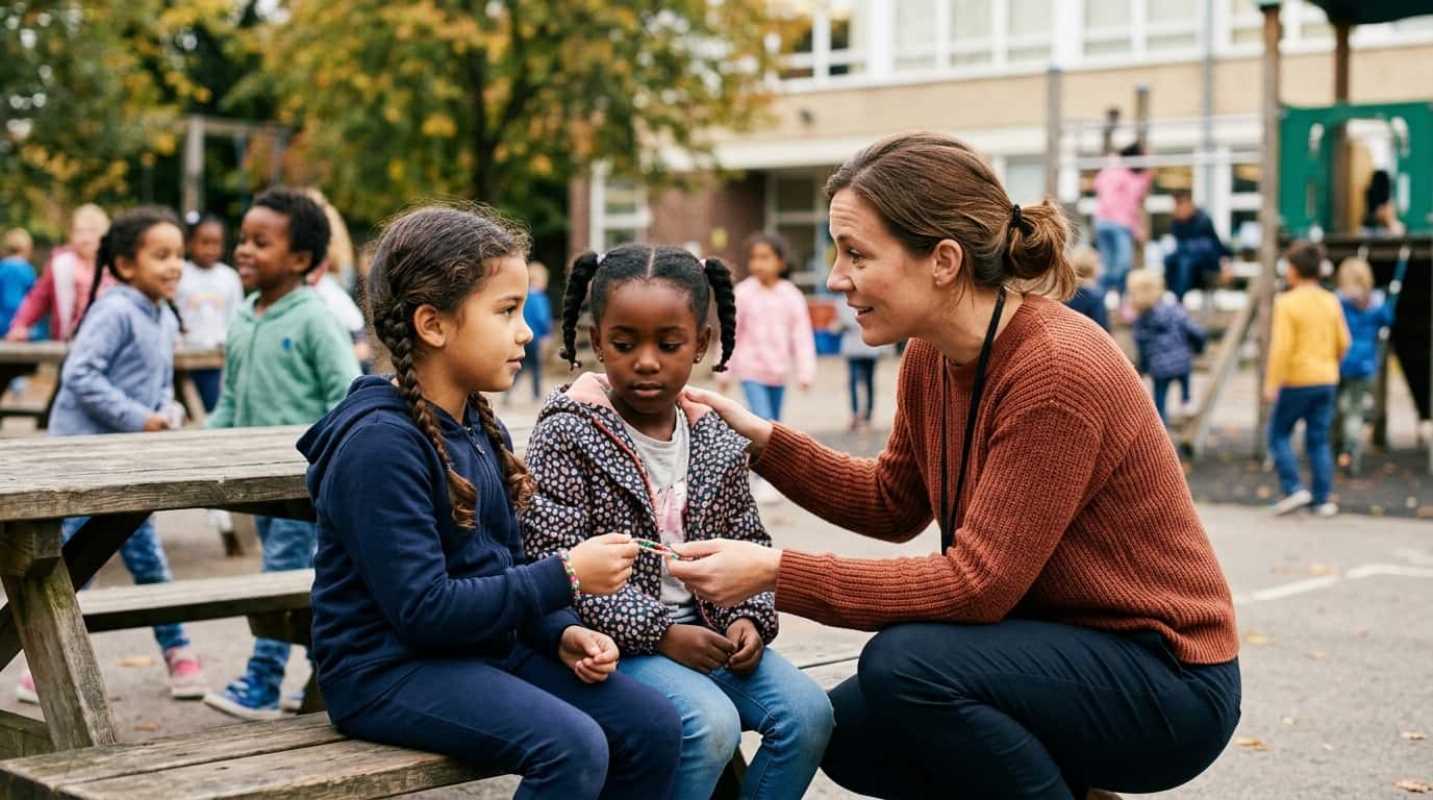
When serious issues arise, contact teachers, counselors, or school staff quietly. Focus on building a safety net behind the scenes rather than fighting your child's battles directly on the playground.
Raising Socially Resilient Kids
Teaching kids to handle friendship conflicts is a marathon, not a sprint. Your child will make mistakes. They will say the wrong thing, blow their top, or get their feelings hurt again next week. That is all part of learning.
Your goal is not to protect your child from every uncomfortable social situation. Your goal is to show them that conflict is a temporary problem they have the skills to solve.
By listening with empathy, coaching from the sidelines, and giving them practical tools, you give your child something far more valuable than a smooth day at school. You give them the emotional foundation to build strong, healthy, and lasting connections for the rest of their lives.
Sources:
1. For Teens' Mental Health, Strong Friendships Matter More Than Social Media Use, NIH Study Finds
https://echochildren.org/for-teens-mental-health-strong-friendships-matter-more-than-social-media-use-nih-study-finds/
2. Insights for Navigating Adolescent Friendships
https://www.nais.org/resource-center/independent-ideas/august-2025/insights-for-navigating-adolescent-friendships
3. New Study Shines Light on Friendships for Our Kids
https://www.thechildrenstrust.org/news/parenting-our-children/new-study-shines-light-on-friendships-for-our-kids/
*This article on FactBlast is for informational and educational purposes only. Readers are encouraged to consult qualified professionals and verify details with official sources before making decisions. This content does not constitute professional advice.*