Walk down the beauty aisle today, and you are bombarded with hundreds of serums, acids, and multi-step routines. Social media feeds are packed with influencers showing off their ten-step glass skin regimens. It is easy to feel like you are falling behind if you are not layering five different products before bed. But here is a secret your skin wishes you knew. More products do not equal better results. In fact, the modern obsession with complex skincare is often doing far more damage than good.
Have you ever noticed your skin getting redder, flakier, or more breakout-prone despite using a shelf full of premium products? You are not alone. It is time to simplify your approach and understand how less is often more for achieving healthy skin.
The Dark Side of Cleansing Habits
We have been conditioned to believe that a deep, squeaky-clean feeling means our face wash is doing its job. But according to clinical guidance, that tight sensation is actually a warning sign. It means you have stripped away your skin's needed lipids and damaged its natural moisture barrier.
When you wash away these protective oils, your skin panics and overproduces sebum to compensate. This leads to a frustrating cycle of oiliness and breakouts.
Washing your face with hot water is another common mistake. The American Academy of Dermatology warns that hot water strips away the natural sebum that keeps your skin supple. You should always stick to lukewarm water instead.
Dr. B.L. Jangid, founder of the SkinQure Clinic, warns that blindly following complex cleansing trends without understanding your skin type frequently leads to burns, acne flares, and long-term damage.¹
If you want to know if your cleansing habits are hurting your skin, look out for these telltale signs
• Post-wash tightness: Your skin feels stretched or dry immediately after towel drying.
• Squeaky texture: The skin feels completely stripped of any natural slip or softness.
• Flakiness and redness: Dry patches appear in areas that are usually balanced.
The Epidemic of Over-Exfoliation
Exfoliation is great for promoting cell turnover and revealing fresh skin. But there is a very thin line between a healthy glow and completely destroying your acid mantle.
A 2024 survey by the International Dermal Institute revealed that 68% of U.S. dermatologists treated patients for adverse skin reactions caused by at-home exfoliation products. Many of these cases involved severe barrier damage and contact dermatitis.
Dr. Marisa Garshick, a dermatologist at Weill Cornell Medicine, warns that going overboard with physical scrubs and chemical exfoliators strips the protective barrier. This leads to redness, breakouts, sensitivity, and microtears. She recommends limiting exfoliation to no more than three times a week.
Have you ever noticed your face looking incredibly shiny, yet feeling dry and tight underneath? Dermatologists call this the shiny but dehydrated paradox. Your stratum corneum has been stripped so thin that it acts like a mirror, but the underlying tissue is crying out for moisture.
If your skin is burning, red, or breaking out from too many acids, you need a reset
• Stop all actives: Put away your retinoids, vitamin C, and exfoliating acids immediately.
• Focus on hydration: Use only a gentle, non-foaming cleanser and a barrier-repair moisturizer.
• Give it time: Stick to this basic routine for two to three weeks until your skin barrier heals.
Sunscreen Use and The Most Common Misconceptions
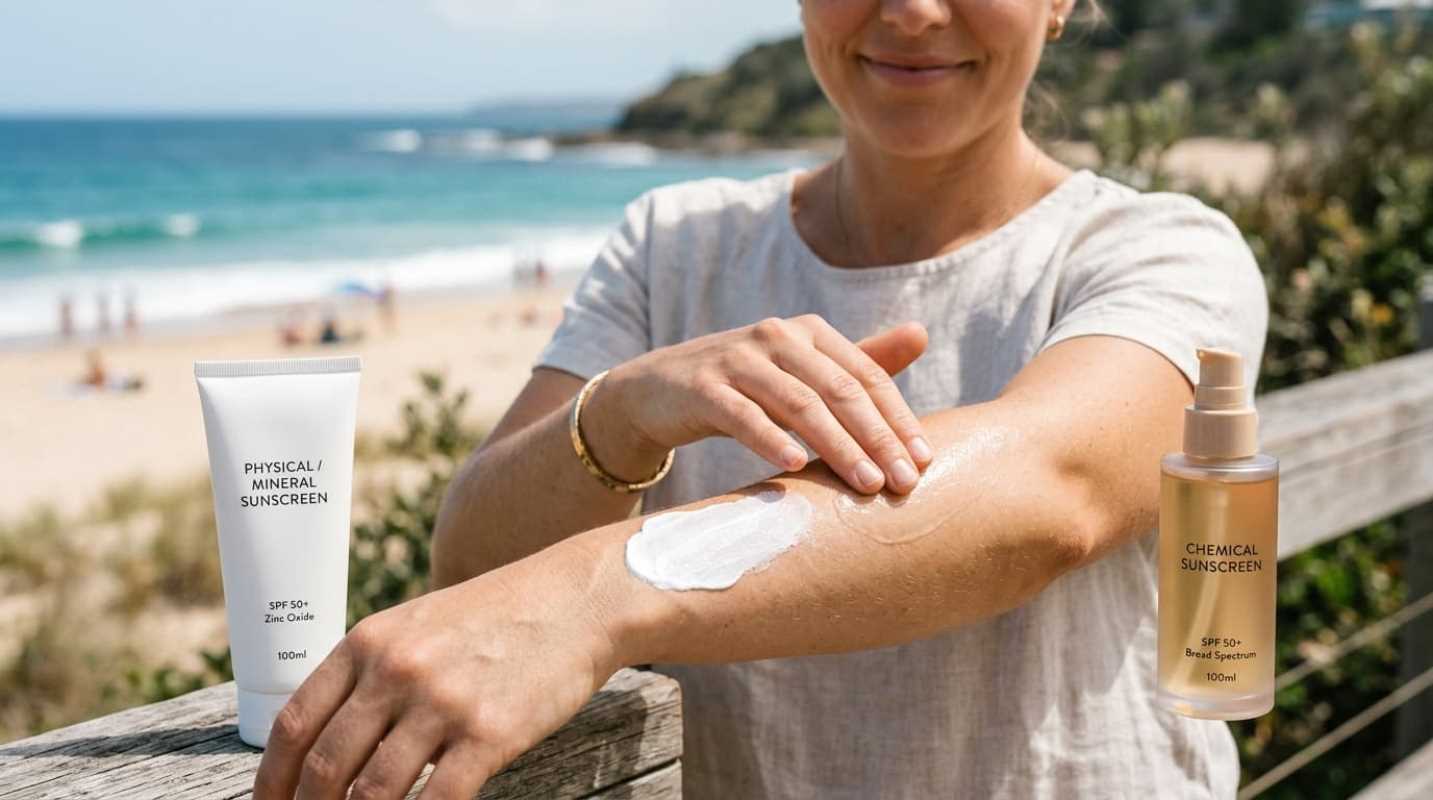
Sunscreen is the single most important product in your routine, but it is also the most misunderstood. Social media has fueled a dangerous anti-sunscreen movement. Board-certified dermatologist Dr. Dustin Portela notes that one in seven Americans under 35 now believe that wearing sunscreen daily is more harmful than going without it.
This is a dangerous myth, especially since one in five Americans will develop skin cancer in their lifetime. If you are using active ingredients like retinol at night, skipping SPF the next morning is a recipe for disaster. Retinol makes your skin highly sensitive to UV rays, meaning you are accelerating collagen breakdown and sun damage if you go unprotected.
Many people also overestimate high SPF numbers. Dr. Jeanine Downie explains that SPF 15 blocks about 93% of UVB rays, while SPF 50 blocks about 98%.² A higher number does not mean you can apply a tiny dot and expect it to last all day.
How much do you actually need?
• The face and neck: You need a coin-sized amount of sunscreen to get the actual protection listed on the bottle.
• The body: You need about 30 milliliters, which is roughly two tablespoons, to cover your body.
• The timing: You must reapply every two hours, especially if you are sweating or swimming.
Do not rely on the SPF in your makeup, either. You would need to apply ten times the normal amount of foundation to get the advertised sun protection.³
Even the format of your sunscreen matters. In July 2025, the FDA issued warning letters to several major brands regarding unapproved sunscreen formats like whipped mousses and foams. Whipped formats may not provide uniform coverage, leaving your skin vulnerable to damage. The FDA clarified that only lotions, creams, gels, butters, pastes, ointments, and sticks are legally recognized as safe and effective over-the-counter formats.
Ingredient Layering and The More is Better Fallacy
The temptation to layer active ingredients is incredibly strong. You want the brightening power of Vitamin C, the anti-aging benefits of retinol, and the clearing power of salicylic acid. But mixing these potent ingredients simultaneously is a recipe for widespread barrier dysfunction.
Certain ingredients do not play well together. Like, using Vitamin C and retinol at the exact same time can cause severe irritation and render both products useless.
Instead of playing chemist in your bathroom, simplify your routine. Introduce new products slowly, one at a time, and always perform a patch test on your jawline or inner arm first.
A streamlined routine is always more effective than a chaotic, ten-step process. Keep your morning routine focused on protection (cleanser, Vitamin C, moisturizer, and SPF) and your night routine focused on repair (cleanser, retinol or acid, and a rich moisturizer).
Embracing a Sustainable Skincare Philosophy
Your skin is a living organ, not a test tube for every new beauty trend. When you try to force too many ingredients onto your face, your skin will inevitably rebel.
Consistency always beats complexity. You do not need a complicated shelf of products to achieve healthy, radiant skin. You just need a few high-quality, well-chosen products that support your skin's natural functions.
Listen to your skin. If it feels tight, red, or irritated, it is telling you to slow down. By stripping back your routine and focusing on the basics, you will give your skin the space it needs to heal, protect itself, and truly glow.
Sources:
1. Dermatologist shares 4 skincare mistakes you need to leave behind
https://www.hindustantimes.com/lifestyle/health/dermatologist-shares-4-skincare-mistakes-you-need-to-leave-behind-in-2025-many-adverse-outcomes-can-come-from-101765455820655.html
2. Common skincare mistakes dermatologists see
https://www.london-dermatology-centre.co.uk/blog/common-skincare-mistakes-dermatologists-see/
3. Common skincare mistakes
https://www.prevention.com/beauty/skin-care/a65821349/common-skincare-mistakes/
*This article on factblast.net is for informational and educational purposes only. Readers are encouraged to consult qualified professionals and verify details with official sources before making decisions. This content does not constitute professional advice.*