Have you ever stood in the skincare aisle, staring at dozens of sunscreen bottles, feeling completely lost? You see terms like "broad spectrum," "mineral," "chemical," and "zinc oxide" tossed around on every label. It is easy to pick whatever is on sale and hope for the best. Choosing the right sunscreen actually matters quite a bit for your daily health. Unprotected exposure to ultraviolet rays causes up to 90% of visible facial aging, from fine lines to dark spots.¹ Daily use of a broad-spectrum SPF 15 or higher cuts visible skin aging by nearly a quarter compared to skipping daily application.¹ Beyond aesthetics, daily protection helps guard against skin cancer, which affects roughly 1 in 5 Americans during their lifetime.¹
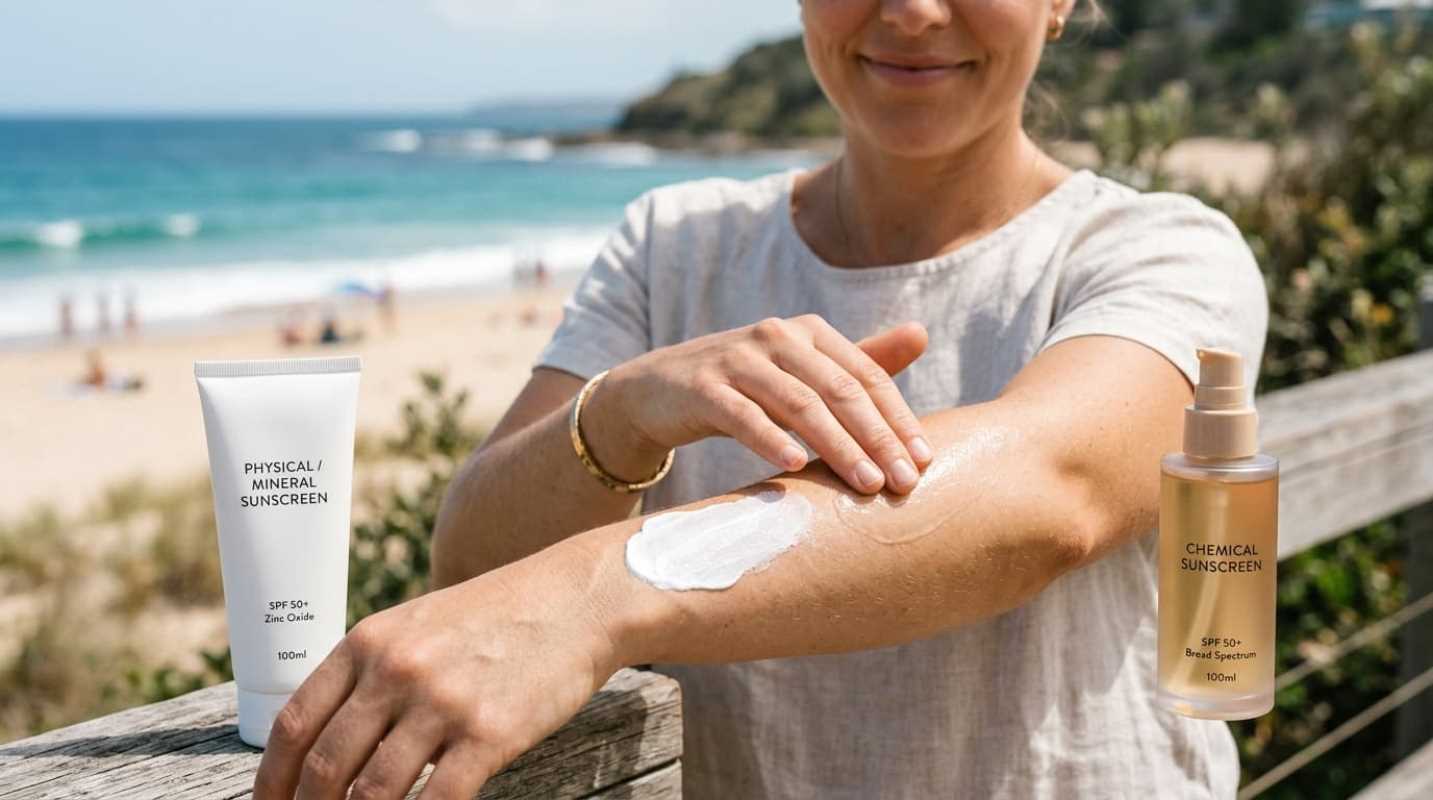
The debate usually boils down to physical versus chemical formulas. Both shield your skin, but they do it in completely different ways using different ingredients. Once you understand how each type works, picking the right product for your face becomes simple.
Physical Sunscreens: The Mineral Shield
Physical sunscreens, often called mineral sunscreens, rely on active mineral ingredients to protect your skin. The two primary ingredients you will see on the back of these bottles are Zinc Oxide and Titanium Dioxide.
For years, people believed mineral sunscreens worked purely like a physical mirror on your skin, bouncing 100% of UV rays away. Modern science paints a slightly different picture. Spectrophotometric testing shows that mineral filters actually absorb roughly 90% to 95% of incoming UV light, converting it harmlessly, while scattering and reflecting only about 5% to 10%.
Physical formulas offer some major perks. They are stable, work immediately upon application, and rarely cause allergic reactions. Zinc oxide also has natural soothing properties, making it great for irritated skin.
The main drawback? Texture and appearance. Because physical minerals do not dissolve into water or oil, older or basic formulas can feel heavy and leave a chalky white cast on your face. That white cast is actually visible light scattering off the mineral particles. Fortunately, modern micronized formulas and tinted versions help solve this problem.
Chemical Sunscreens: The Molecular Absorbers
Chemical sunscreens take a molecular approach to sun protection. Instead of relying on ground minerals, these formulas use carbon-based organic compounds that sink into the top layers of your skin.
When UV light hits your skin, these chemical filters absorb the photons through a photochemical reaction. They convert that radiation into low-level heat, which then dissipates from your body. Common ingredients in American formulas include Avobenzone, Octisalate, Octocrylene, Homosalate, and Oxybenzone. Farther abroad in Europe and Asia, you will find newer, highly stable filters like Bemotrizinol that offer incredible protection with minimal skin absorption.²
Why do so many people prefer chemical sunscreens for daily wear? Cosmetic elegance. Chemical filters dissolve cleanly into lightweight lotions, creams, and gels. They spread easily, leave zero white residue, and sit invisibly under makeup.
The trade-off is that traditional chemical filters require about 15 to 20 minutes to bind with your skin before they become fully effective. Some older chemical filters can also cause mild stinging or eye watering if you sweat.
Ingredient Comparison and Performance
When you compare physical and chemical sunscreens side by side, their real-world performance depends heavily on how you live and apply them.
• Application and appearance: Chemical sunscreens blend effortlessly into all skin tones without leaving a white trace. Physical formulas can require extra rubbing and may look grayish on deep complexions unless you use a tinted version.
• Wait time before exposure: Physical sunscreen works the moment it touches your skin. Chemical formulas need 15 to 20 minutes to absorb before you step out into direct sunlight.
• Durability and reapplication: Both types degrade under direct light and rub off with sweat or friction. Regardless of which formula you choose, you must reapply every two hours when outdoors, or after 40 to 80 minutes of swimming.
You might have heard floating health concerns about chemical sunscreens. The FDA recently asked manufacturers for modern safety data on several organic filters after studies showed small amounts enter systemic circulation.² But dermatologists stress that systemic absorption does not mean a product is toxic or unsafe. Skin cancer remains a proven, serious health risk, whereas current sunscreens are safe when used as directed.²
Skin Type Suitability: Finding Your Perfect Match
Finding your ideal sunscreen comes down to your personal skin concerns, complexion, and lifestyle habits.
• Sensitive, rosacea, or reactive skin: Mineral sunscreens are usually the top pick. Zinc oxide is gentle and non-irritating. Chemical sunscreens convert UV rays into heat energy, which can occasionally trigger vasodilation and flush rosacea-prone skin.
• Darker skin tones and melasma: Clear chemical sunscreens excel at avoiding a chalky residue on deeper skin tones. But if you struggle with melasma or stubborn dark spots, a tinted physical sunscreen is even better. The iron oxides used to tint mineral formulas help block visible blue light from electronics and the sun, which can trigger pigmentation.
• Oily or acne-prone skin: Fluid or gel-based chemical formulas offer a weightless feel that won't clog pores. If you prefer minerals, look for oil-free, liquid mineral fluids designed specifically for matte finishes.
When layering sunscreen into your morning routine, keep things simple. Apply your regular serum and moisturizer first, let them sink in for two minutes, and then apply your sunscreen as the final step of your skincare. If you wear makeup, let your SPF dry for three to five minutes before applying foundation so you do not disturb the protective film.
Bottom Line: The Best Sunscreen is the One You Wear Regularly
It is easy to get caught up in the debate between physical minerals and chemical absorbers. But at the end of the day, protection comes down to simple daily habits.
Dermatologists agree that effective sun protection requires three simple features: broad-spectrum protection against UVA and UVB rays, an SPF rating of 30 or higher, and water resistance if you plan to sweat or swim.³
Both mineral and chemical sunscreens can protect your skin from premature aging and sun damage. The best sunscreen isn't the most expensive one or the one with the fanciest packaging. It is the bottle sitting on your counter that you actually enjoy putting on every single morning. Pick the formula that feels great on your skin, wear it consistently, and enjoy the outdoors with confidence.
Sources:
1. American Academy of Dermatology
https://www.aad.org/media/stats-sunscreen
2. U.S. Food and Drug Administration
https://www.fda.gov/drugs/understanding-over-counter-medicines/sunscreen-how-help-protect-your-skin-sun
3. Dermatology Seattle
https://dermatologyseattle.com/our-clinic/blog/sunscreen-guide/
*This article on FactBlast is for informational and educational purposes only. Readers are encouraged to consult qualified professionals and verify details with official sources before making decisions. This content does not constitute professional advice.*